Showing posts with label Indian. Show all posts

Monday, October 6, 2014

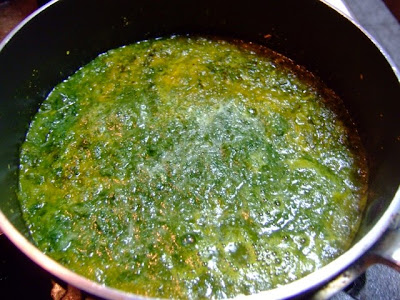
Spinach Curry

Spinach curry takes fresh greens and turns them into sauce. Other mild greens and herbs can also be mixed in. I’ve used kale, epazote and cilantro. Spinach curry can also be combined with other vegetables, such as potato.


Green curries are alternative to other red (tomato) and yellow (turmeric root) curries.

BASE
- 1 bunch (8 oz) spinach (200 g, may substitute kale)
- 1 onion, cut half
SPICE
- 3 tbsp curry paste (ginger, garlic, turmeric, chili, lime)
- 1/2 tsp salt
- 1 lime, juice

Pressure cook spinach and onion with 1/2 cup water 3 min. Blend onion, 1/2 spinach and cooking water. Cut reserved spinach.
In pot simmer curry paste, blended greens, reserved greens.
Add salt and lime juice to taste.

Yellow Curry Paste

Made of ginger garlic paste with equal parts ginger and garlic, with turmeric root and serrano chili. Keeps 1 week in refrigerator. Can add lime juice to preserve.
Makes 15 tablespoons paste.


SPICE
- 4-6" ginger root, chopped coarse
- 20 cloves garlic, peeled
- 4-6" turmeric root, chopped coarse
- 2 serrano chili, whole, chopped coarse
- 1 lime juice

In small blender, food processor or mortar and pestal, blend ingredients. Add just enough water to blend. Avoid too much water.

Potato Curry

Simple potato curry uses yellow curry paste. My yellow curry paste is ginger, garlic, turmeric, serano chili, lime and water. Serve with rice. Garnish with grilled red onions and fresh cilantro.


BASE
- 3 white potatoes, 1/4 inch cubes
SPICE
- 2 tbsp curry paste (yellow curry)
- 1/2 tsp salt

In pot of water boil potatoes until done, and drain.
In pressure cooker with 1/2 cup water raise press 3 min, cool, and drain.
In pan simmer curry paste and salt. Add water as needed to keep wet.
Add potatoes and mix until covered with sauce.


Thursday, December 29, 2011

Green Lentil Curry

This mung bean dal is a rustic spicy soup or curry. Warm and colorful soup, good served with flatbread or rice.

Mung beans are type of green lentil common in Indian and Chinese cooking. They can be purchased whole and split with a couple of pulses of a food processor.

Ingredients
MAIN
1 cup split mung beans, (green lentils)
SPICE
1 in fresh ginger, chopped
1 whole green chili pepper
1/2 tsp turmeric
2 cups water
FINISH
2 plum tomatoes, chopped
1 tsp cumin seeds, ground
1 tsp garam masala
1/4 tsp salt
handful fresh cilantro, chopped

Preparation
In pot add split mung beans, ginger, whole chili, turmeric and water, and bring to boil, 10 min. With strainer remove foam.
(Use split mung beans, or use whole mung beans and give 5-10 pulses in food processor, until more beans are split open than not. Don't process too much, or you quickly get just lentil flour and dust.)
Then reduce heat and simmer, 15-25 min., until lentils are tender.
Meanwhile, in spice grinder, grind cumin seeds. After lentils have simmered, add tomatoes, cumin powder, garam masala and salt, and simmer additional 10 min. (Total cooking time for lentils is 45-55 min.) Garnish with fresh cilantro and serve.
Quick use of stick blender turns into finished soup, or serve chunky and rustic. (Remember to remove the chili if you don't want hot!)

NOTES
Curry can be made more or less hot by adding or leaving out chili pepper.

Wednesday, December 28, 2011

Cookbook Download

My cookbook of everyday Indian rice recipes, with photos and recipes, tips and ingredients, as EPUB file for download. 11 recipes, 18 Photos, 6 Drawings, 82 Pages.


My goal was a dozen rice recipes for breakfast, lunch and dinner. All recipes have photos, ingredients and preparation. Also shopping and pantry tips, and cooking methods and tips. This is my first effort, so it's first draft or beta quality. Comments are welcome.
Recipes are brown rice, whole plant, no added oils, no meat or dairy, vegetarian, vegan and McDougall friendly.

Monday, November 14, 2011

Rice and Lentils

There are many variations on rice and lentils from India through the Middle East. Onions and carrots make the base, and are both native to the region. The spices here are simple, just cumin and coriander, bay leaf, and a pinch of turmeric and salt.


Ingredients
BASE
1/2 onion, sliced thin
1 carrot, chopped small
SPICE
1 clove garlic, minced
1/2 tsp cumin, ground
1/2 tsp coriander, ground
1/8 tsp salt
1/8 tsp turmeric
MAIN
3/4 cup brown rice, soaked
1/4 cup lentils, soaked (whole brown or red lentils)
FINISH
1/2 lemon juice

Preparation
Prep: Soak lentils & rice.
Base: Brown and saute the onion & carrot. Result should be moist, not wet. This base gets added to the rice and lentils, along with spices, and it's flavor gets absorbed.
Main: Mix veggie base, ground spices, rice & lentils in pot or rice cooker, with water. Bring to boil, then simmer covered, 20-30 min, then remove heat, and continue steam covered, 10-15 min.
Finish: Adjust taste with lemon juice and garnish with fresh coriander leaves.

Friday, November 11, 2011

Rice Lentil Soup

Rice lentil soup is traditional breakfast (kitchari).


Ingredients
MAIN
1 cup brown rice, soaked
1/2 cup green dal, soaked
2 cups water (or more)
SPICE
1/8 tsp turmeric
1/8 tsp salt

Preparation
Simmer until rice and lentils soft and mushy. May require extra water.

Monday, November 7, 2011

Coconut Rice Soup

This is a simple soup, lightly flavored. Leftover cooked rice is broken up and cooked as soup. The base is shallot-garlic-ginger which makes a light broth if water and no extra broth is added. Medium grain rice is slightly sweeter than long grain. Coconut is added for slightly richer flavor.


Ingredients
BASE
2 shallots, sliced thin
1 tsp garlic, sliced thin
1 tsp ginger, sliced thin
1 cup water or light broth
SPICE
1/8 tsp salt
MAIN
1 cup medium grain brown rice, cooked
2/3 cups water
FINISH
1/8 cup shredded coconut, soaked (optional)
1 tbsp lemon juice

Preparation
In saucepan at medium heat, covered, sweat shallots, ginger and garlic, 5-10 min.
In food processor or blender, mix cooked rice and enough water to mix. Use a few short bursts to break rice, but don't puree.
Add rice mixture to saucepan, add enough water or light broth to make soup, and salt, and bring just to boil.
Add coconut and lemon juice to taste.

Saturday, November 5, 2011

Rice Pancakes

Pancake batter require a full day and night preparation. But once the batter is prepared, pancakes cook quickly. Traditional pancakes soak and grind rice and lentils, then ferment the batter. Spices are mixed into the batter. The ratio varies for rice to lentils between 2:1 (brown rice) to 5:1 (white rice.) Ingredients vary, with different variety of rice and lentils, and different spices. Size and thickness vary, from pancake thickness to paper thin crepes.


Preparation: 24 hours
Cooking: 6-8 minutes

Ingredients
MAIN (BATTER)
1 cup medium grain brown rice, soaked
1/4 cup whole black lentils, soaked (urad dal)
1 cup water, soaking
1 cup water, grinding (as needed)
SPICE
1/4 tsp fenugreek seeds (option)
2 tbsp chickpeas (option)
1/8 tsp salt
FINISH
1 banana or other fresh fruit

Preparation
Soak: Soak rice and lentils separately, 4-6 hours (morning.)
Grind Batter: Drain and reserve excess soaking water. Grind lentils separately to very fine paste, soft and foamy. Grinding lentils separately fine makes fluffy pancakes. Grind rice and fenugreek seeds to fine grain, smooth. Add reserved soaking water as necessary to thin batter. Batter should be thick, but pour easily from ladle, or through fingers. Batter thickens with ferment.
Ferment: Set room temperature or warmer, loosely covered, 6-8 hours (overnight.)
Grind Spices: Grind fenugreek seeds and mix spices, fenugreek and salt, into batter. (May also wet grind whole spices with lentils or rice.)
Cook: Blend fermented batter and spices. Add water to adjust thickness. Preheat non-stick pan to medium heat. (I prefer light non-stick omelet pan.) Water drops added spatter. Batter should be room temperature. Pour or ladle batter into flat rounds of desired size. 1 ladle makes 5 inch pancake, light brown (not golden brown.) Bubbles appear, then pop or subside, and change color. Turn with spatula. Cook to golden brown. Remove to plate and serve hot. (Between pancake batches, wipe clean hot pan with damp towel or sponge.)

Monday, February 28, 2011

Spicy Eggplant and Potato Curry

I found this dish at my favorite Indian restaurant in San Francisco among the vegetarian curries. Eggplant was a novel vegetable for me, but a standard and versatile vegetable in places as diverse as India and Italy. Small and large eggplants work equally well. Serve with brown rice or whole grain flat bread.


Ingredients
BASE
1 medium onion peeled and chopped
1/2 tsp cumin seed ground
1/4 tsp red chili flakes ground
1/8 tsp black peppercorns ground
1/2 inch ginger peeled and chopped or grated
2 cloves garlic peeled, crushed and chopped
1/4 tsp turmeric
MAIN
1/2 large eggplant with skin, diced (4-6 cups)
2 medium potatoes peeled and diced
FINISH
1/4 tsp salt
1/2 tsp garam masala
2 tbsp fresh cilantro leaves, torn

Preparation
To grind whole spices: Grind cumin seed, red chili flakes and black peppercorns into coarse powder in spice grinder. Set aside.
To start base: Brown onion, lowering heat once it colors, 10-12 min. Add splash of water, garlic, ginger, and ground spices, and simmer 2-3 min. Then add chopped eggplant and potatoes, and continue to simmer without a lid; as eggplants cook they will release enough water to cook the potatoes, and when water escapes, the sauce with thicken, 30-45 min.
To finish: Mix in garam masala, continue simmer 5 min, adding or boiling water as necessary for moist gravy thickness. Garnish with fresh corriander leaves and serve hot with brown rice or whole wheat flatbread.

Spicy Cauliflower and Potato, Aloo Ghobi

This curry starts with a vegetable flavor base of browned onion and tomato, with aromatics and freshly ground whole spices. I like to think of cauliflower as the main ingredient, with potato added. The common Indian name Aloo Gobi has this reversed, potatoes and cauliflower. This dish served dry also makes a good filling for a whole wheat pita.


Ingredients
BASE
1 med onion sliced
2 med plum tomatoes diced
1 inch ginger peeled, chopped or grated
2 cloves garlic peeled, crushed and chopped
1 tsp cumin seed ground
1 tsp coriander seed ground
1/4 tsp red chili pepper ground
1/8 tsp black peppercorn ground
1/4 tsp turmeric
1/4 tsp salt
MAIN
1 small head cauliflower chopped (or 1/2 large head)
2 medium potatoes peeled and cubed
FINISH
1/4 tsp garam masala
1 handful fresh cilantro chopped

Preparation
To grind whole spices: Grind cumin seed, corriander seeds, red chili pepper flakes and black peppercorns into coarse powder in spice grinder. Set aside. This step can be done while browning onions, along with prepping the main ingredients.
To start base: Brown onion, lowering heat once it colors, 10-12 min. Add splash of water, ginger, garlic, and ground spices, and simmer 2-3 min.
Main: Then add chopped cauliflower and potatoes, stir, cover and continue to simmer, 30-45 min.
To finish: Uncover and mix in garam masala, continue simmer 5 min, adding or boiling water as necessary for moist gravy thickness. Garnish with fresh corriander leaves and serve hot with brown rice or whole wheat flatbread.

Tuesday, January 11, 2011

Chickpea Curry

Chickpeas make hearty and tasty vegetable. Highlighted with lots of roasted cumin. The roasted cumin is divided in half, with first half added early to base to lend flavor, and second half added to finish to lend aroma.

Ingredients
BASE
1/2 onion chopped
1 medium plum tomato chopped
1/2 cup water
SPICE
2 cloves garlic crushed and sliced thin
1/2 inch ginger grated
2 tsp cumin seed ground
1/2 tsp turmeric
1/2 tsp coriander seed ground
1/2 tsp red chili pepper ground
1/8 tsp salt
MAIN
1 can chickpeas drained
FINISH
1/2 tsp garam masala
1/4 tsp black peppercorn ground
handful fresh coriander

Preparation
To roast spice, in saucepan preheated with medium heat, roast the cumin seeds until aroma, 30-60 sec. Remove from heat immediately and pour from pan into small bowl to cool. After cool, grind to coarse powder in spice grinder, 10 sec. Also separately grind coriander seeds and red chili pepper.
To make the base, in small saucepan brown onion, 10-20 min. Can save time by browning onions in batches and using saved brown onions. Add tomato and cook, 3 min. Allow the tomato to saute, not boil. Add water, garlic, ginger, 1/2 roasted cumin, coriander, turmeric, red chili pepper, and boil 2-3 min. Water keeps garlic from burning. Remove from heat and allow to cool slightly. With stick blender, puree the tomatoes into gravy.
Now for the main ingredient, the chickpeas. Add chickpeas and bring to boil, cover and simmer 5 min. Mash 2 tbsp chickpeas and stir.
To finish, add garam masala, 1/2 ground roasted cumin, black pepper and fresh coriander and stir.

Green Pea Rice Pilaf

Rice dish that gets flavor from brown onions and spices. Especially easy if you make brown onions in batches. Just add some fresh or frozen peas.

Ingredients
1 cup brown rice soaked
1/2 onion chopped
1 cup water
1/4 cup peas
1 tsp garam masala
1/8 tsp salt
1 tbsp lemon juice

Preparation
Prepare by soaking brown rice, 2 hrs. Wash and drain.
In saucepan, brown onion, 10-20 min. Brown onions should be moist with most of moisture removed, so they neither add nor subtract water to the rice. (Cumin seed is a simple substitution for garam masala.)
To rice cooker, add rice, onion, peas, spices and water. Start cooking, 35-45 min. Salt to taste.
Drizzle lemon juice to taste and fluff with fork.

My Indian Cooking Roadmap

One of my goals in learning Indian Cooking was to learn proper use of spices, which I knew Indian Cusine used to make tasty dishes, in many cases vegetarian. I started with rice dishes, because rice appeared to the the main starch, and probably the most basic and easiest to cook. Next I was led to lentils, which cooked similar to rice, by my cookbooks. The last and hardest dishes to get right were curries.
So I've grouped and ordered recipes into:
  • Rice dishes
  • Lentil dishes
  • Curry dishes
These dishes also make up meals. Any meal with just one dish gets boring, no matter how tasty. A lentil soup serves as an appetizer, a rice dish serves as the main starch, and a curry dish serves as a vegetable side.

So meals look like:
  1. Lentil (soup, appetizer)
  2. Rice (starch, main)
  3. Curry (vegetable side, over rice or with flat bread)
While I think of rice and flat bread as the nutritional center, the curry is usually the real star. A few other dishes like chutney condiments, snack and deserts round out the taste and texture palette.

Sunday, January 9, 2011

Cooking Without Oil

Most Indian recipes use cooking techniques with oils. Is it possible to cook Indian cuisine without oil? If it is possible, does it taste good? Traditional Indian cuisine is generally slower cooking, and tastes just as good with the flavors from whole plant ingredients and flavor bases, which slowly combine and release their naturally packaged macronutrients including natural oils, without adding any processed and packaged oils.


Why are oils commonly used? Oils are commonly used in pan frying to avoid sticking, to use high heats to cook faster, and to carry flavors. Each of these is just a convenient technique for a cooking problem and result, but none of these is the only way to get the desired result. Historically oils would have been both expensive and prone to spoilage. Preference is matter of choice, and while one choice is convenience, another choice is quality and simplicity. My preferred technique uses the flavors and tastes from ingredients in their fresh and whole natural packages, going a bit slower, and emphasizing quality. Let's look at each problem and how to get the desired results.
  1. Avoid Sticking: To avoid sticking, use a non stick pan, lower the heat, and deglaze with a splash of water. All three of these avoid the burning and sticking that using oil also prevents. Which gets used depends on circumstances. Often I use regular saucepans to brown onions, or mix flavor bases, stocks and gravies.
  2. High Heat (Browning): To brown vegetables, especially onions, just go low and slow. Browning takes heat, dryness and alkalinity, but not necessarily high heat. You get dryness when the surface moisture of your vegetable is vaporized. Then the outside starts to brown. Cutting smaller and thinner helps evenly dry and then brown your vegetables. If you must go hot and fast, use a non stick pan. Alkalinity is usually fixed by your vegetable ingredients, but you can, for example, add baking soda to onions to increase alkalinity and brown onions faster. Don't bother, it adds nothing to flavor.
  3. Carry Flavor: To carry flavor just use water or vegetable purees. All whole plants also contain some oils that are released into sauces. Add ingredients like spices early to the base to allow flavors to absorb and mix. Moisture carries flavor better into dry ingredients like grains and pulses.
So packaged oils are not needed, and you get truer flavors by using lowering the heat, go low and slow, deglazing, using a non stick pan, and using water or purees to carry flavor. Common packaged vegetable oils like soybean, canola and olive do not add authentic flavors to Indian cuisine, and flavors from mustard and peanut can be had just by using whole mustard seed and peanuts.

To summarize the methods to cook without oil:
  1. Use non stick saucepans particularly for higher heats.
  2. Lower heat and go slow to brown.
  3. Use vegetable bases and water to carry flavor. 
You can see putting these methods to use in the examples of toasting spices, browning onions and vegetables, and making stocks and soups.

Spices: Use medium-high heat, with non stick pan. Toast the spices in the non stock pan, then set aside to cool and grind. Then mix the ground spices into stock, soup or gravy, where water and moisture, not oil, infuses and spreads the flavor. Recipes commonly fry spices and herbs using oil. Note you can not grind oily spices. So this usually means keeping duplicate powdered spices in the pantry. I prefer to toast whole spices first, to dry and enhance flavor, then grind whole spices into mix or powder. When discussing spices, I mean the whole dry spices that store well, not fresh herbs. Most herbs are more delicate and should be simmered at lower heats. For example, garlic can easily burn and become bitter. Herbs don't get toasted and instead are add to the moist flavor base.

Onions: Use low heat and go slow. Recipes commonly fry onions at high heats to brown them faster. If you're not working as short order cook, brown your onions low and slow. They don't burn as easily. You can also brown a couple of onions in batches that keep refrigerated for up to 3 days, which really cuts cooking times.

Vegetables: Use medium heat and non stick pan to roast and brown the outside of vegetables, like potatoes and sweet peppers. Use a tight fitting clear lid for keeping steam and keeping an eye on the vegetables, sometimes adding a spash of water. Lightly brown the outside of vegetables before adding to dishes like curries.

Stocks and Soups: Use liquids to carry the flavors. Add whole or ground spices, brown onions and roasted vegetables directly to water in cooking stocks and soups. Stocks and soups are are easy to cook without oil. Stocks and soups often cook dried ingredients, like rice and pulses. Water moisture makes this possible, not oil. When the dried ingredients absorb water, they both absorb the flavor and give back to the flavor of the stock and soup.

For more details, see my recipe tips for Toasting Cumin and Browning Onions.

Thursday, December 30, 2010

Grinding Spices

In a couple of seconds, with the touch of a button, a teaspoon of cumin seeds, a teaspoon of fennel seeds, and a teaspoon of crushed red pepper becomes a custom spice mix. All it takes is a small and inexpensive electric coffee grinder or spice mill, available at any household goods store. At first, grinding your own garam masala, or spice mix seems exotic. Soon it's just like using a food processor.

A small coffee grinder, used just for spices, turns whole spices into fresh powders right in your kitchen. Grinding the whole spices releases an explosion of flavor, especially if the spices are toasted first. Often toasting is done to dry out damp spices, but sometimes toasting really brings out the flavor, such as with toasted cumin seeds.

Once you start grinding whole spices, you find yourself grinding fresh spices for practially every recipe.


Whole Spice
The aromatic oils and compounds in spices are why we use them, and the flavor keeps best in nature's packages. Whole spices keep a year or more. The famous East India Company traders shipped whole spices. For many spices, I used to have both jars of powders and whole, and now keeping just whole spices simplifies my spice rack. You should throw away any spices more than 1 year old, and most powders (except turmeric.)

Why whole spice?
- Whole spice tastes better.
- Whole spice keeps better.
- Whole spice is more flexible; whole can be used either whole or ground as needed.
- Reduces clutter of duplicate spice jars, if you had both whole and ground versions.

Spice Powder
Ground spices release their flavor quickly, and are generally added late to a dish. In contrast, slow cooked dishes generally use whole spices, which have plenty of time to break down, and form a base or bottom layer of flavor complexity. Quick dishes and finishes, however, use powdered spices, to release their flavor right away, and form a finish or top layer of flavor complexity.

Why spice powders?
- Increased surface increases flavor and speeds absorption.
- Blends into sauces and gravies.

Roasting Spices
- Sometimes spices are dry roasted to reduce moisture, to make grinding easier, particularly in moist climates.
- Sometimes spices are dry roasted is to cook and transform flavors. Mustard seeds pop and change flavor when roasted.

Preparation
- To toast spices, use a dry pan on medium heat, add spices, and watch closely until spices start to release aroma, 1-3 min. Remove immediately from heat, and from pan into into measuring cup. This stops further roasting or burning.
- Grind small amounts, as needed.
- Grind until big piece clatter stops, generally only 5-10 sec.
- Some spices benefit from roasting. This heats and changes their aromatic oils and compounds. Mustard seed and cumin seed are examples.
- Damp spices should be toasted lightly to dry before grinding.
Wednesday, December 29, 2010

Garam Masala (Spice Mix)

A masala means a spice mix. The most commonly used spices in Indian cuisine, cumin, corriander, black pepper, cardomom, cinnamon, cloves and bay leaves, are commonly mixed and ground and used to finish many dishes.
A small coffee grinder, used just for spices, turns whole spices into fresh powders right in your kitchen. Grinding the whole spices releases an explosion of flavor, especially if the spices are toasted first. Often toasting is done to dry out damp spices, but sometimes toasting really brings out the flavor, such as with toasted cumin seeds.


Ingredients
1 tbsp cumin seed
1 tbsp coriander seed
1/2 tsp black peppercorns
10 cloves
1 in cinnamon stick
2 cardamom pods
2 bay leaves

Preparation
Optionally, in pan on medium heat, toast cumin seeds lightly, 3 min. Remove from heat and let cool. Measure whole spices into spice grinder, close lid, and grind for 10-30 seconds. Pour freshly ground powder mix into measuring cup, or using funnel pour directly into empty spice jar.
Ground powder keeps at least a couple of weeks.

Steamed Brown Rice

Plain steamed brown rice is usually prepared as an ingredient for other dishes like lemon rice (great use of leftover rice), or as a side dish for sauces like curries. Steamed rice can be dressed up a bit adding a few small vegetables like peas, and common seasoning like cumin and salt.


Ingredients
1 cup brown rice soaked
1 cup water
1/8 tsp salt
1/2 tsp cumin seed ground
1/4 cup green peas

Preparation
Soak: plan ahead and at morning or noon, measure dry rice and soak, 2 hr. Test by biting a single kernel of wet rice. Wet rice will not crunch like dry rice. Rinse and drain.

Cook: Add rice and water to rice cooker. Add any optional spices and vegetable. Close lid and start cooking and steaming, 35-45 min. When finished, fluff lightly with wooden spoon and serve.

Rice Cooker
- Not enough water, boils out too soon, and undercooks the rice. Rice kernel is hard.
- Too much water, takes forever to boil out, and overcooks the rice. Rice is mushy and sticky.
- Soaked rice both absorbs less water (add less water), and cooks faster (add less water), than dry rice. Start with 1:1 ratio of soaked brown rice to water. (Directions that call for more water probably don't soak the rice.)
- Set a timer to 45 min for the rice cooker. This will guarantee you don't forget the rice. A timer also make you aware of how long the rice boils and steams. When rice cooker switches from boil to steam, note how much time the brown rice boiled (probably 20-30 min), and reduce the timer to 15 min.
- Best use your own measures and ignore the measure and marks provided by the rice cooker. The rice cooker provided measure cup is only 3/4 cup (180 ml), while pan side marks are 2x that, or 1-1/2 cup (360 ml).

Browning Onions

In making my own base and stocks, it all starts with onions. It seems cooks are always chopping and browning onions. Julia Child famously practiced simply chopping onions when she attended cooking school in Paris. Many recipes start with browning onions. Browning the onions combines their proteins and sugars. The taste is quite different from steamed or boiled onions. Browning onions usually takes longer than the recipe claims. Browning onions happens in stages: translucent, golden and finally brown. It's unnecessary and counterproductive to use any fats or oils, or even a non-stick pan. (You want the onions to stick slightly.) Too much heat, and the onions blacken and burn.


Ingredients
1 onion, chopped

Preparation
Soften: Place onions in regular (not non-stick) saucepan, over medium heat, with lid on. Allow the onions to steam, until they become translucent, 5-10 min. The moisture in the onions becomes steam, and largely keeps the onions from burning. During this time they can mostly be ignored, except perhaps for an occasional stir. You usually catch an aroma when they're done.
Taste test the plain translucent onions.

Brown: Remove the lid, and continue to cook, and allow onions to almost burn slightly, another 5-10 min. As the onions loose moisture they will begin to turn golden and stick to the bottom of the pan. Stir with a wooden spoon, scraping the bottom of the pan. If necessary, use a bit of cold water to deglaze the bottom of the pan, scraping the loose bits from the bottom with a wooden spoon. I usually stop here, when onions are nice golden brown.
Taste test the golden onions.

This process goes faster if you use high heat, watch closely, and stir and deglaze often. This results in fully brown onions. Taste test the brown onions.

Brown onions in advance, and store covered 2-3 days in refrigerator.
Cook uncovered during softening to speed the process. But watch more carefuly.

Carrot Rice

Very fragrant and tasty, dressed up with almonds and golden raisins.


Ingredients
1 cup brown rice soaked
1/4 cup slivered almonds
1 onion chopped
2 carrots grated
2 inch cinnamon ground
2 pods green cardamoms ground
1 pod black cardamom ground
2-3 bay leaves ground
1/4 tsp salt
1 cup water
1/4 cup golden raisins
handful cilantro

Preparation
Prepare by soaking brown rice at least 2 hours. Wash and drain.
In saucepan, brown onions, 5 min. Add carrots and saute, 5 min. Meanwhile, use spice grinder to grind cinnamon, cardamoms and bay leaves. In another saucepan, lightly toast almonds, until golden brown. Set aside.
In rice cooker, combine rice, carrot base, spices, raisins, almonds and water. Ratio of rice to water is important. Turn on rice cooker. Rice cooker automatically boils and cooks until water is gone, 30 min, then steams warm, 15 min. After steaming 15 min, open lid and stir.
Garnish with cilantro leaves and serve.